


The engineering mentality for language learning, being ready & input vs output

Full disclosure: This post contains affiliate links. ?

For those of you who don't know my background, I have a Bachelor's degree in Electronic Engineering and actually worked as an engineer several times. Perhaps you would think that it's hardly the pre-requisite for becoming a full time language hacker, but I actually feel that my engineering background has been a big contributor for my success with languages.
You see, engineering is a very practical hands-on field. Engineering is built upon scientific principles, but takes them even further into a non-ideal world that is filled with lots of interference that can never be fully covered by equations at a practical level, until an efficient solution to a problem is found.
Engineering isn't about perfection. Real systems have constraints, losses and trade-offs, so engineers work towards a solution that is safe, useful and ready to test. Engineering produces results in the form of machines, technology and structures.
Because of this, engineering results are always adapting and improving, even though a solution has already been presented. Cell phones get faster and buildings withstand harsh climates better. But if we waited until we had the level of advancement we had now before even actually applying anything, we'd still be living in caves and yelling across hills.
To show you what I mean, let me compare my personal engineering approach to languages compared to what I consider a more traditional approach, using engineering style illustrations while I'm at it!
A note from the Fluent in 3 Months team before we get started: You can chat away with a native speaker for at least 15 minutes with the “Fluent in 3 Months” method. All it takes is 90 days. Tap this link to find out more.
The ready asymptote
An asymptote is a line or limit which a curve gets closer and closer to but never actually touches. This is how I describe most people's view of when they'll be “ready to speak” as shown below:
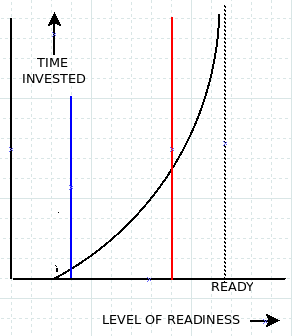
The problem with being “ready” is that there is ALWAYS more work to do. There are more obscure words to learn, grammar points and tones to perfect, intonations, cultural differences etc. You will never ever know a language perfectly, so you will never be “ready” if you define ready as “not being able to make any mistakes”.
If you make perfection the threshold for speaking, you can spend years studying without trying to use the language.
It's the same in engineering; heat loss, molecular dispersion, friction and a host of other factors mean that we can never design a perfect system/device. So what we do is to try our best and then accept a “pretty good” solution as the one to apply immediately.
In professional contexts this would be represented by the red line. You work hard, but begin testing when the solution is good enough for that stage. Waiting for absolute perfection would prevent useful feedback.
In a system where people's lives are at stake (a bridge's resistance to wind, the accuracy of an aeroplane's sensory detection system etc.), your threshold should be as close as possible to the ideal. But long before you get there, you need to TEST and apply your solution in the field. You simply cannot make a quantum leap from start to next-to-perfect without thorough testing first.
And this is what I do with languages. I set my “ready to speak” threshold much lower, like at the blue line, which is where I'll be after a few short hours of studying.
When I'm trying to communicate in a language, nobody's lives are at stake. If I conjugate my verb wrong or forget some basic vocabulary, the worst that can happen is that someone laughs at my mistake (which almost never happens, since people are way nicer than the pessimists would have you believe). But I can laugh with them and move on, rather than declare it to be the end of the world.
As engineers, we reach more professional levels of efficiency through repeated testing in real-world environments. As a language learner I do the same thing, seeking out tourists, Couchsurfers or others to practise with. What I have in my first months is not enough for a guest lecture at a local university, but I can still say a lot and form friendships. That practice then gives me useful feedback.
The stage where you speak well becomes more attainable when you take small steps through actual use. Study matters, but using the language in the meantime reveals what you need to practise next.
Impossible to start from zero
One other thing you'll notice about the above graph is that at time zero, your readiness level is NOT zero. Perhaps in a theoretical (and pessimistic) system you can approximate everything you know in a foreign language to nothing, but this isn't how it actually is.
You may recognise some names, international terms or shared vocabulary when you start a new language. How much transfers varies greatly by language. You also bring experience with non-verbal communication, even though gestures and social cues vary across cultures.
You are not starting from absolute zero. You are starting as an adult who already knows how to learn, notice patterns and interact with other people. That experience does not replace language-specific learning, but it gives you useful tools from the beginning.
Facial expressions, gestures, personal space and turn-taking are not identical everywhere. Still, your ability to pay attention, ask for clarification and adjust to another person means you are starting with more than a blank page.
Following a more theoretical approach, as too many language learners do, you'll never get the feedback you need to be able to progress, which brings me on to the next point:
The input vs output fallacy
Input and speaking are often presented as opposing methods, but they can support each other. In this discussion, Stephen Krashen and I compare comprehensible input with early speaking:
One thing that has surprised me a lot in reading other blogs related to languages is this supposed “debate” about input vs output. Some of them put me in the “output” camp with my early start to speaking to contrast with their long-term input focused approach.
That contrast can be useful for discussion, but a social human being is more complex than a single input-output diagram.
When you first look at a system, it may appear to have just one or two inputs and outputs. Engineers revise that simple model as the system's complexity becomes clear.
One version of the argument says that learners should delay speaking because early mistakes might become habits. That risk is worth considering, but it does not require treating input and interaction as mutually exclusive.
I see people with this argument to visualise “the human learning system” with input as follows:
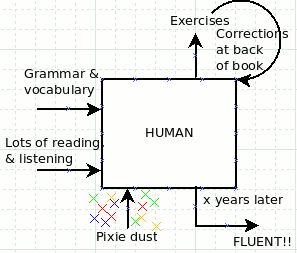
(I added the pixie dust myself; it's the only way I can see this system as being in any way more realistic).
Without all of that pure input (although you'll note that even in their system pure input is impossible; they need feedback at least from their books), they imagine someone who speaks as soon as possible to be nothing but an output machine full of mistakes.
Someone using the communicative approach to language learning that I promote combines input with attempts to communicate. In engineering, one of the most important aspects of many systems is feedback.
There is no system that simply involves input in the real world. In biology, mirror neurons, gene regulatory networks, and hormones (among many others) are systems that rely on feedback. In mechanical engineering the float valve is a good example of physical feedback based on the environment (used to regulate fuel in a carburettor, and more familiarly in toilets).
Feedback can make a learning system more efficient, and successful language learners use it at many stages of their learning cycle.
My view of the language learning system is too complex to illustrate here. It would have arrows going in as input, arrows going out as speech or writing, and information returning as feedback. Books and exercises can help, but interaction gives you different evidence about what another person understands.
That's where people come in, and you can't illustrate a person as a simple feedback loop of corrections. They'll give you encouragement, and the feeling of use with human beings is a great motivation to work towards as you are learning. No simplified A+B=C system can ever represent that.
Be an engineer and get your hands dirty!
In this blog I talk about attitude a lot and push people to change their behaviours. This is because I feel like my experience is allowing me to look at the overall system of speaking a language a lot better. If you look at it as “study grammar+vocabulary + do exercises + listen a lot = be fluent in a few years” you are looking at it with tunnel vision.
I think many people who do try to analyse language learning like this are indeed being somewhat “scientific”. You can do studies, read up a lot about it in advance etc. and feel you will be best prepared. But the real world does not answer directly to our simplified equations, because we cannot realistically factor in all “inputs”.
Being social and lots of practice is my engineering approach to learning languages. It's learning by doing. I'll make mistakes along the way, but the overall approach will constantly get better. Just reading up about how to do it, or investing in courses will never give me that.
It's time to get your hands dirty and tackle languages as an engineer would! Make a plan of action quickly and implement it.

Social