


How to Say “Happy Birthday” in Korean: 4 Useful Versions

Full disclosure: This post contains affiliate links. ?
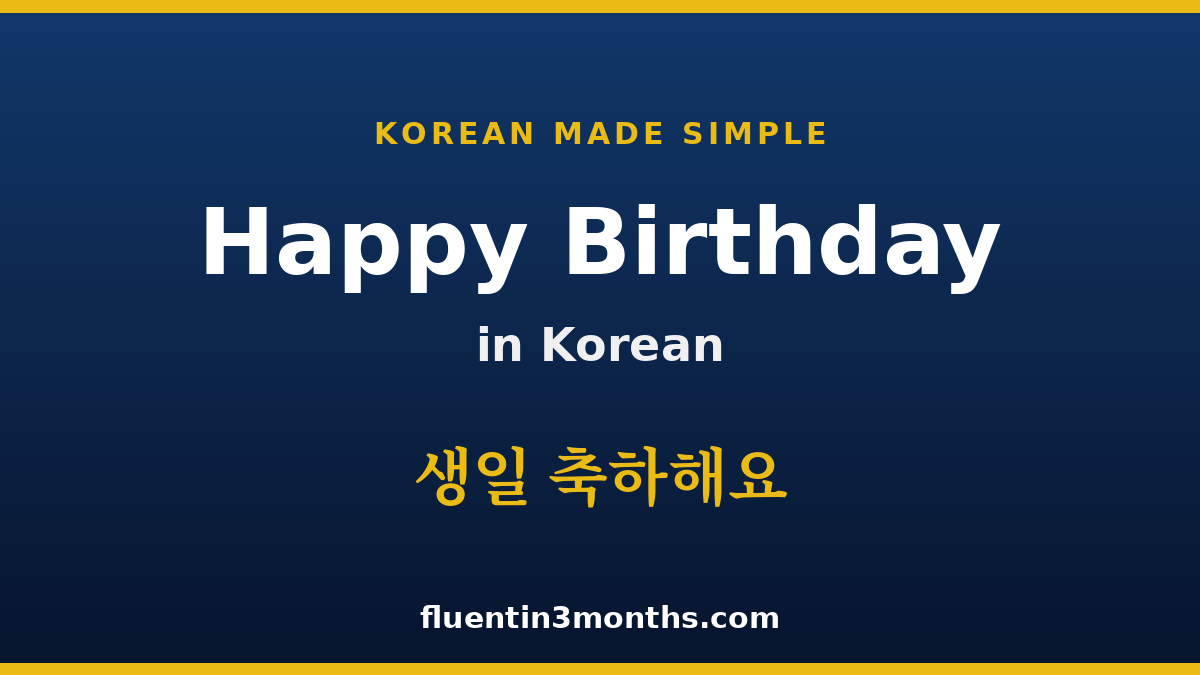
The most useful everyday way to say “happy birthday” in Korean is 생일 축하해요 (saengil chukhahaeyo). You can use it in plenty of situations, but Korean birthday greetings also change with your relationship to the person and the setting.
That does not mean there is one rigid four-step ladder. Korean combines speech style, politeness and honorific vocabulary, so a formal ending and an honorific word are doing different jobs. These four versions will give you a practical starting point, along with the Korean birthday song, useful birthday words and a few traditions you may come across.
How to Say “Happy Birthday” in Korean
The everyday phrase is:
- 생일 축하해요 (saengil chukhahaeyo) – “Happy birthday”
Here is how it breaks down:
- 생일 (saengil) – “birthday”, from the Sino-Korean elements for birth and day
- 축하해요 (chukhahaeyo) – the everyday polite form of 축하하다 (chukhahada), “to congratulate” or “to celebrate”
Korean therefore phrases the greeting as congratulating someone on their birthday. The -해요 ending makes this version polite without sounding ceremonial, so it is a useful default with acquaintances, colleagues and people you do not speak to casually.
Four Common Versions, from Casual to Honorific
The relationship matters more than a simple age comparison. In particular, someone being younger than you does not automatically make casual speech appropriate. Korean speakers normally use 반말 (banmal), casual speech, in an established close relationship or after agreeing to speak casually.
- 생일 축하해 (saengil chukhahae) – casual. Use it with close friends, siblings or other people with whom you already use 반말.
- 생일 축하해요 (saengil chukhahaeyo) – everyday polite. This is the safest version to learn first when you are unsure.
- 생일 축하합니다 (saengil chukhahamnida) – formal polite. You will hear it in speeches, announcements and more formal workplace or public settings.
- 생신 축하드립니다 (saengsin chukhadeurimnida) – an especially respectful greeting for a parent, grandparent or respected senior.
The last version changes more than the sentence ending. 생신 (saengsin) is the honorific form of “birthday”, while 드리다 (deurida) is a respectful, humble verb used when giving or offering something to someone you honour. That is why 생신 축하드립니다 carries more deference than simply switching to a formal ending.
The Korean Birthday Song
The Korean birthday song uses the familiar “Happy Birthday to You” tune:
- 생일 축하합니다 (saengil chukhahamnida)
- 생일 축하합니다 (saengil chukhahamnida)
- 사랑하는 [이름] (saranghaneun [ireum]) – “dear [name]”
- 생일 축하합니다 (saengil chukhahamnida)
Groups may vary how they fit the person's name or an address term into the third line. The conventional lyrics use the formal 합니다 form, even when the singers would use a different speech style with the birthday person in conversation.
Useful Korean Birthday Words and Wishes
You only need one or two extra wishes for a card or message, so pick the ones that suit the person rather than trying to use the whole list.
Simple wishes:
- 행복하세요 (haengbokhaseyo) – “Be happy” or “I wish you happiness”
- 건강하세요 (geonganghaseyo) – “Stay healthy”
- 좋은 하루 보내세요 (joeun haru bonaeseyo) – “Have a good day”
- 축하해요! (chukhahaeyo) – “Congratulations!” This also works for good news that has nothing to do with birthdays.
Birthday words and actions:
- 생일 파티 (saengil pati) – “birthday party”
- 생일 케이크 (saengil keikeu) – “birthday cake”
- 선물 (seonmul) – “present” or “gift”
- 촛불을 끄다 (chotbureul kkeuda) – “to blow out” or “to extinguish the candles”
- 소원을 빌다 (sowoneul bilda) – “to make a wish”
Romanisation can help you find your place at first, but it cannot show every Korean sound accurately. Add the phrases you expect to use to your own deck and review them with audio; our guide to making Anki cards will help you set that up.
Korean Birthday Traditions
미역국 (miyeokguk), seaweed soup, is closely associated with birthdays and with recovery after childbirth in Korea. Eating it on a birthday recalls the soup traditionally given to new mothers and, for many people, their mother's care around the time of their birth. Customs vary by household, so it is better understood as a familiar birthday tradition than a rule every Korean family follows.
A child's first-birthday celebration is called 돌잔치 (doljanchi). Reaching the first birthday carried particular weight when infant mortality was much higher. One part of the celebration is 돌잡이 (doljabi), in which objects are placed in front of the child and the one they choose is treated as a playful prediction of their future. Traditional examples include thread for a long life, money for wealth and a writing tool for learning.
Korean Age after the 2023 Law Change
Under the traditional counting system, 세는 나이 (seneun nai), a baby is one at birth and everyone gains a year on New Year's Day. This can make the count one or two years higher than the international age, depending on the date.
Amendments that took effect in June 2023 established 만 나이 (man nai), the international system, as the standard in South Korea's civil and administrative law. You may still hear 세는 나이 in social conversation, while some specific laws use another calculation called 연 나이 (yeon nai), or “year age”. If the exact age matters, confirm which system the speaker or rule is using.
How to Pronounce 생일 축하해요
The spelling-based romanisation saengil chukhahaeyo is a reading aid, not an exact pronunciation guide. Two details are especially useful:
- 축하해요 is pronounced [추카해요]. When ㄱ meets ㅎ here, they combine into a ㅋ sound, so there is no separate pause between “chuk” and “ha”.
- The vowel ㅡ, represented by eu in romanisation, does not have a close English equivalent. It is produced without rounding the lips, so native audio is much more useful than an English spelling approximation.
For native audio and structured lessons, you can try KoreanClass101; our KoreanClass101 review explains what the service is like.
A Short Note on Hangul
King Sejong's scholars completed the writing system now called Hangul in 1443, and the explanatory book Hunminjeongeum was published in 1446. Its five basic consonant shapes model the speech organs used to make their sounds. For example, ㄱ represents the shape of the tongue root blocking the throat.
Learning the letters will take you beyond the rough clues that romanisation can offer. Our guide to the Korean alphabet walks through the consonants, vowels and syllable blocks.
Ready to Celebrate in Korean
If you are unsure which version to use, start with 생일 축하해요. Save 생일 축하해 for a relationship where you already use casual speech, and reach for 생신 축하드립니다 when you want to honour a parent, grandparent or respected senior.
From here, our guide to saying hello in Korean is a natural next step. If you would like structured support turning phrases into conversations, that is what we work on inside the Fluent in 3 Months Bootcamp.
생일 축하해요!

Social